
The Effect of 3D Animated Video Education on Knowledge of Postoperative Pain Management Among Anesthesiology Nursing Students at Universitas 'Aisyiyah Yogyakarta
DOI:
https://doi.org/10.58545/jkmi.v5i2.765Abstract
Postoperative pain is a common problem experienced by surgical patients and requires appropriate management to improve recovery and patient comfort. Therefore, anesthesiology nursing students need adequate knowledge regarding postoperative pain management before entering clinical practice. The use of innovative educational media, such as 3D animated videos, is expected to improve students’ understanding more effectively than conventional learning methods. This study aimed to determine the effect of 3D animated video education on the knowledge level of anesthesiology nursing students regarding postoperative pain management. This study employed a quantitative approach with a quasi–experimental pretest–posttest control group design. A total of 60 anesthesiology nursing students at Universitas Aisyiyah Yogyakarta participated in this study and were divided into an intervention group and a control group, with 30 respondents in each. Data were collected using a knowledge questionnaire and analyzed using the Wilcoxon Signed-Rank Test and the Mann–Whitney U Test. The results showed a significant increase in knowledge scores before and after the intervention in both groups (p = 0.000). Furthermore, the intervention group demonstrated significantly greater knowledge improvement than the control group (p = 0.000). It can be concluded that 3D animated video education is effective in improving students’ knowledge of postoperative pain management.
Keywords:
3D animated video, Education, Knowledge, Postoperative, Pain managementDownloads
References
Aji, A., Suprapto, P., Handayani, N., & Rosidah, I. (2025). Pengaruh video edukasi terhadap pengetahuan pencegahan infeksi nosokomial di rumah sakit pada mahasiswa. Jurnal Ilmu Kesehatan, 14(November), 136–141. https://ojs.widyagamahusada.ac.id/index.php/JIK/article/view/423
Almarzooq, Z. I., Lopes, M., & Kochar, A. (2020). Virtual learning during the COVID-19 pandemic: A disruptive technology in graduate medical education. Journal of the American College of Cardiology, 75(20), 2635–2638. https://doi.org/10.1016/j.jacc.2020.04.015
Andreyani, L., & Bhakti, W. K. (2023). Validitas skala ukur nyeri visual analog and numerik ranting scales (VANRS) terhadap penilaian nyeri. Jambura Journal of Health Science and Research, 5(2), 730–736. https://doi.org/10.35971/jjhsr.v5i2.19140
Choeron, R., & Metrikayanto, W. D. (2025). Memahami konsep infark miokard akut melalui media video pembelajaran. Jurnal Ilmiah Keperawatan (Scientific Journal of Nursing), 11(2), 171–176. https://doi.org/10.33023/jikep.v11i2.2492
Efkelin, R., Ramba, H. La, Suarti, N. M., Martini, M., & Rahmaningsih, A. (2023). Efektivitas pembelajaran dengan metode e-learning pada mahasiswa keperawatan. An-Najat, 1(2), 200–208. https://doi.org/10.59841/an-najat.v1i2.204
Fatonah, S., Rahma Bakri, S., Tanjungkarang, P., & Studi Sarjana Terapan Keperawatan. (2023). Hubungan tingkat pengetahuan dengan penerapan perawat tentang manajemen nyeri non farmakologi pada pasien post operasi. Jurnal Ilmu Kesehatan Indonesia (JIKSI), 1(1), 1–7.
Fauzi, A. K. A., & Purnamasari, V. (2024). Pengaruh edukasi menggunakan video balut bidai terhadap efikasi diri mahasiswa keperawatan anestesiologi Universitas 'Aisyiyah Yogyakarta. Jurnal Kolaborasi Kesehatan, 1, 73–84. https://jurnal.kolibi.org/index.php/husada/article/view/2028
Halmuniati, H., Riswandi, D., Zainuddin, Z., & Asmin, L. O. (2022). Efektivitas media pembelajaran berbasis video animasi terhadap hasil belajar fisika. Jurnal IPA & Pembelajaran IPA, 6(4), 332–340. https://doi.org/10.21831/jipi.v6i4.579
Handayani, N., Purnamasari, V., Anestesi, P., & Android, B. S. (2023). Edukasi penatalaksanaan non farmakologi komplikasi pasca anestesi melalui buku saku berbasis Android. Jurnal Kesehatan Kusuma Dewa, 14(1), 82–90. https://www.jurnal.ukh.ac.id/index.php/JK/article/view/973
Handayani, S. L., Sulistyaningsih, D. R., Suyanto, S., & Melastuti, E. (2025). Faktor pemberian terapi non farmakologi oleh perawat kepada pasien dengan nyeri post operasi di rumah sakit: Studi literatur. Jurnal Ners, 9(3), 4042–4048. https://doi.org/10.31004/jn.v9i3.44497
Jamal, & Fachrul. (2022). Tinjauan pustaka: Penilaian dan modalitas tatalaksana nyeri. Jurnal Kedokteran Nanggroe Medika, 5(3), 66–73. https://doi.org/10.35324/jknamed.v5i3.211
Kartini, S., Bagenda, E. F., & Hartati, S. (2025). Pengaruh edukasi kesehatan terhadap pengetahuan ibu tentang pencegahan stunting pada balita. Jurnal Ilmu Kedokteran dan Kesehatan Indonesia (JIKKI), 5(1), 300–313. https://researchhub.id/index.php/jikki/article/view/7203
Kindangen, M., Tulung, J. M., Massang, B., et al. (2022). Media audio visual dalam pembelajaran pendidikan agama Kristen: Studi tentang motivasi belajar siswa di masa pandemi. Educatio, 8(1), 337–343. https://doi.org/10.31949/educatio.v8i1.2050
Mayer, R. E. (2021). Multimedia learning (3rd ed.). Cambridge University Press. https://doi.org/10.1017/9781316941355
Murtiningsih, & Hanif Abdul Latif. (2021). Sosiologi. Jurnal Pendidikan dan Pembelajaran, IX, 302–309.
Park, R., Mohiuddin, M., Arellano, R., Pogatzki-Zahn, E., Klar, G., & Gilron, I. (2023). Prevalence of postoperative pain after hospital discharge: Systematic review and meta-analysis. British Journal of Anaesthesia. https://doi.org/10.1016/j.bja.2023.04.026
Putra, A. D., & Salsabila, H. (2021). Pengaruh media interaktif dalam perkembangan kegiatan pembelajaran pada instansi pendidikan. Inovasi Kurikulum, 18(2). https://ejournal.upi.edu/index.php/JIK/article/view/36282
Rahman, Z. (2023). Pengaruh edukasi kesehatan terhadap self care pasien diabetes melitus tipe 2. Jurnal Ilmiah Keperawatan, 9(3), 577–581. https://doi.org/10.33023/jikep.v9i5.1620
Rahmawati, D., Sari, N., & Kurniawan, A. (2022). Efektivitas media audiovisual terhadap peningkatan hasil belajar mahasiswa kesehatan. Jurnal Pendidikan Kesehatan Indonesia, 10(1), 45–52.
Rachmadina, T., Muladi, A., Sarjana, P., Keperawatan, T., Insan, P., Surakarta, H., & Tengah, J. (2025). Manajemen nyeri farmakologi pada pasien pasca pembedahan Open Reduction Internal Fixation (ORIF) ekstremitas atas dengan general anestesi. Vitamin Jurnal Ilmu Kesehatan, 11(1). https://journal.arikesi.or.id/index.php/Vitamin/article/view/1456

Downloads
Published
How to Cite
Issue
Section
License
Copyright (c) 2026 Ummulfadilah, Istiqomah Rosidah, Nia Handayani

This work is licensed under a Creative Commons Attribution-ShareAlike 4.0 International License.




Most read articles by the same author(s)
- Qonitah Dhiya Lestari, Ririn Zuhairini, Nia Handayani, Effect of Public Safety Center Video-Based Education on Emergency Response Attitudes Among High School Students , Jurnal Kegawatdaruratan Medis Indonesia : Vol. 5 No. 2 (2026): August 2026
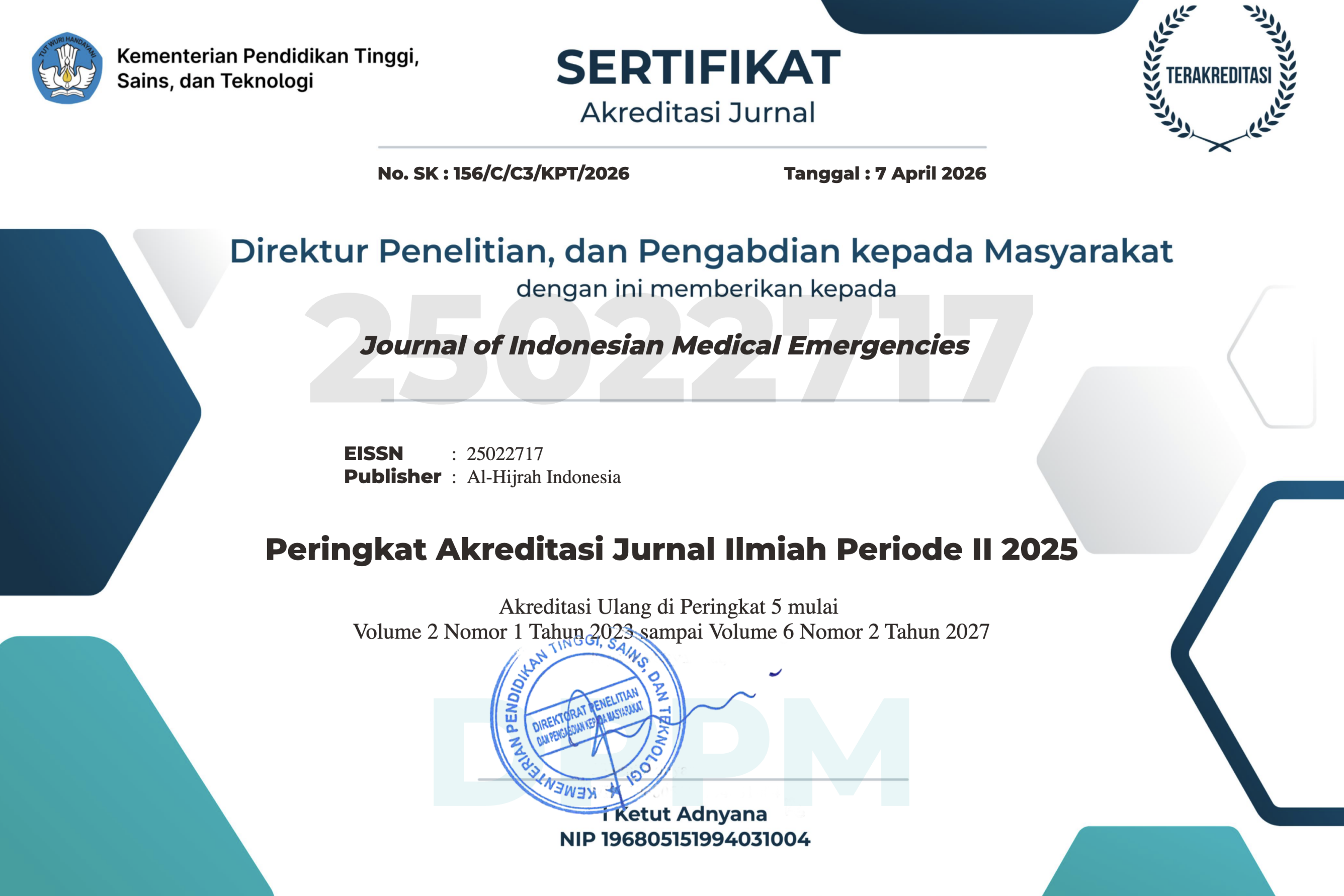
Sinta
JOURNAL TEMPLATE
| JOURNAL TEMPLATE |

Collaboration

issn

DIRECT MESSAGE

PLAGIARISM CHECKER

REFERENCE TOOLS

VISITORS NEW
CROSSREF

Keywords
-
478
-
440
-
403
-
299
-
298