Riding the TIDES: Community Health Adaptation to Flooding in Bulacan
DOI:
https://doi.org/10.58545/jrcnp.v4i2.911Abstract
Background: Flooding represents more than an environmental issue; it poses a profound threat to livelihoods and psychological well-being. For families living in chronically flood-prone areas, it has become a constant fight for survival. Purpose: Although previous studies have examined flood adaptation and disaster resilience, limited research has explored how residents themselves perceive, experience, and adapt to flood-related health challenges through their own visual narratives. To address this gap, this study sought to explore the community health adaptation strategies of barangay residents, the challenges they face, and their aspirations for a healthier, more resilient future. Methods: Using a qualitative photovoice design, 17 purposively selected flood-affected residents documented lived experiences through photographs discussed in semi-structured interviews and focus group discussions. Data underwent inductive thematic analysis. Trustworthiness was ensured through member checking, triangulation, reflexivity, audit trails, and peer debriefing, and code-recoding procedures. Results: The core theme, Riding the TIDES, captured the dynamic process of adapting, persevering, and striving toward resilience amidst flooding. Five themes emerged: (1) Trussed Boundaries of Inundation, (2) Iterative Pathways of Acclimatization, (3) Dialogues of Meaning-Making, (4) Emerging Consciousness of Needs and Aspirations, and (5) Shared Agency and Sustained Solidarity. Conclusion: The findings reveal that adaptation to chronic flooding transcends physical survival and encompasses resilience-building, meaning-making, and collective empowerment. The study contributes a participant-driven understanding of how chronic flood exposure fosters a nuanced form of toxic resilience, in which adaptive capacities coexist with enduring structural vulnerabilities and aspirations for systemic change.
Keywords:
Flooding, Community health adaptation, Photovoice, Resilience, Disaster preparednessDownloads
References
Aguilar, M. V. (2021). Precarious living: Assessing the disaster risk vulnerability of selected informal settlers in Dasmariñas City, Philippines. Harmo ni Sosial Jurnal Pendidikan IPS, 8(1), 39604. https://doi.org/10.21831/hsjpi.v8i1.39604 DOI: https://doi.org/10.21831/hsjpi.v8i1.39604
ActionAid UK. (2025, February 6). Climate change and flooding. https://www.actionaid.org.uk/our-work/emergencies-disasters-humanitarian-response/climate-change-and-flooding-footnote4_KibsMLDvZ-w4A-a8h14juDHHJvEU2FY0mBdmtG60_clkKgi3pqRWQ
Bündnis Entwicklung Hilft. (2025). WorldRiskReport 2025. Bündnis Entwicklung Hilft.
Ciamei, L., & Hollekamp, J. K. (2025). When the waters rise: Disaster resilience in Manila’s informal settler communities. LUP Student Papers. https://lup.lub.lu.se/student-papers/search/publication/9194122
Climate Change Commission & Department of Environment and Natural Resources. (2023). National adaptation plan of the Philippines 2023-2050. https://unfccc.int/sites/default/files/resource/NAP_Philippines_2024.pdf
De Guzman, C., Cabaero, M. L., Lo, J. R., Loro, J., Crisostomo, M. V., Ylade, M., & Agrupis, K. A. (2025). Recent trends in research on the health impacts of climate change in the Philippines (2018–2023): a scoping review. Frontiers in Climate, 7, 1594793. https://doi.org/10.3389/fclim.2025.1594793 DOI: https://doi.org/10.3389/fclim.2025.1594793
Dimitrić, G., Maksimović, N., Tabakova, E., Jakšić, M., Orlić, D., Sadiković, S., Karaba-Jakovljević, D., Zenić, N., & Drid, P. (2021). Personality dimensions of Serbian lifeguards. International Journal of Environmental Research and Public Health, 18(24), 12927. https://doi.org/10.3390/ijerph182412927 DOI: https://doi.org/10.3390/ijerph182412927
Dulawan, J. M. T., Imamura, Y., Amaguchi, H., & Ohara, M. (2024). Social drivers of flood vulnerability: understanding household perspectives and persistence of living in flood zones of Metro Manila, Philippines. Water, 16(6), 799. https://doi.org/10.3390/w16060799 DOI: https://doi.org/10.3390/w16060799
El-Mousawi, F., Ortiz, A. M., Berkat, R., & Nasri, B. (2024). The impact of “soft” and “hard” flood adaptation measures on affected population’s mental health: A mixed method scoping review. Disaster Medicine and Public Health Preparedness, 18, e118. https://doi.org/10.1017/dmp.2024.128 DOI: https://doi.org/10.1017/dmp.2024.128
GMA Integrated News Research. (2025, August 21). Top 20 provinces with the most flood control projects. GMA News Online. https://www.gmanetwork.com/news/topstories/nation/956384/top-20-provinces-with-the-most-flood-control-projects/story/
Harvard Humanitarian Initiative. (2024, November 7). 11 years into Haiyan, Filipinos are better prepared for disasters but still need more support, investments. https://hhi.harvard.edu/blog/11-years-haiyan-filipinos-are-better-prepared-disasters-still-need-more
Hatzikiriakidis, K. (2023). Chapter 17: Photovoice–qualitative research. Council of Australasian University Librarians. https://oercollective.caul.edu.au/qualitative-research/chapter/17/
Heanoy, E. Z., & Brown, N. R. (2024). Impact of natural disasters on mental health: Evidence and implications. Healthcare, 12(18), 1812. https://doi.org/10.3390/healthcare12181812 DOI: https://doi.org/10.3390/healthcare12181812
Lagon, H. M. (2024, November 5). Outgrowing toxic resilience. Philippine Institute for Development Studies. https://www.pids.gov.ph/details/news/in-the-news/outgrowing-toxic-resilience
Mangansat, N. J. M. (2025). Project LEARN: Climate change risk management and adaptive strategies for flood-prone communities. Virtus InterPress. https://virtusinterpress.org/Project-LEARN-Climate-change-risk-management-and-adaptive-strategies-for-flood-prone-communities.html DOI: https://doi.org/10.22495/rgcv15i1p9
McKie, R. E., & Aitken, A. (2025). Community resilience to flooding in the UK: A study of Matlock, Derbyshire. International Journal of Disaster Risk Reduction, 118, 105266. https://doi.org/10.1016/j.ijdrr.2025.105266 DOI: https://doi.org/10.1016/j.ijdrr.2025.105266
Mooney, R., & Bhui, K. (2023). Analysing multimodal data that have been collected using photovoice as a research method. BMJ Open, 13(4), e068289. https://doi.org/10.1136/bmjopen-2022-068289 DOI: https://doi.org/10.1136/bmjopen-2022-068289
Naeem, M., Ozuem, W., Howell, K., & Ranfagni, S. (2024). Demystification and actualisation of data saturation in qualitative research through thematic analysis. International Journal of Qualitative Methods, 23. https://doi.org/10.1177/16094069241229777 DOI: https://doi.org/10.1177/16094069241229777
Namayi, F. S., Makworo, M., & Kibue, S. (2025). The management of climate change-induced flooding in Ziwa La Ng’ombe informal settlement, Mombasa County, Kenya. Africa Habitat Review, 20(1), 3148–3159. https://uonjournals.uonbi.ac.ke/ojs/index.php/ahr/article/view/2715 DOI: https://doi.org/10.66563/772csz50
Norris, F. H., Stevens, S. P., Pfefferbaum, B., Wyche, K. F., & Pfefferbaum, R. L. (2008). Community resilience as a metaphor, theory, set of capacities, and strategy for disaster readiness. American Journal of Community Psychology, 41(1–2), 127-150. https://doi.org/10.1007/s10464-007-9156-6 DOI: https://doi.org/10.1007/s10464-007-9156-6
Panti, L. T. (2025, November 12). COA finds P344-M Bulacan flood control projects as ghost, mismatched. GMA News Online. https://www.gmanetwork.com/news/topstories/nation/965797/coa-finds-p344-m-bulacan-flood-control-projects-as-ghost-mismatched/story/
Philippine Council for Health Research and Development. (2022, March 9). The risks of flooding: Protect yourself from floodwater diseases. https://www.pchrd.dost.gov.ph/news_and_updates/the-risks-of-flooding-protect-yourself-from-floodwater-diseases/
Phouratsamay, S., Scaparra, M. P., Tran, T. H., & Laporte, G. (2024). Strategic flood impact mitigation in developing countries’ urban road networks: application to Hanoi. European Journal of Operational Research, 319(3), 862–876. https://doi.org/10.1016/j.ejor.2024.06.035 DOI: https://doi.org/10.1016/j.ejor.2024.06.035
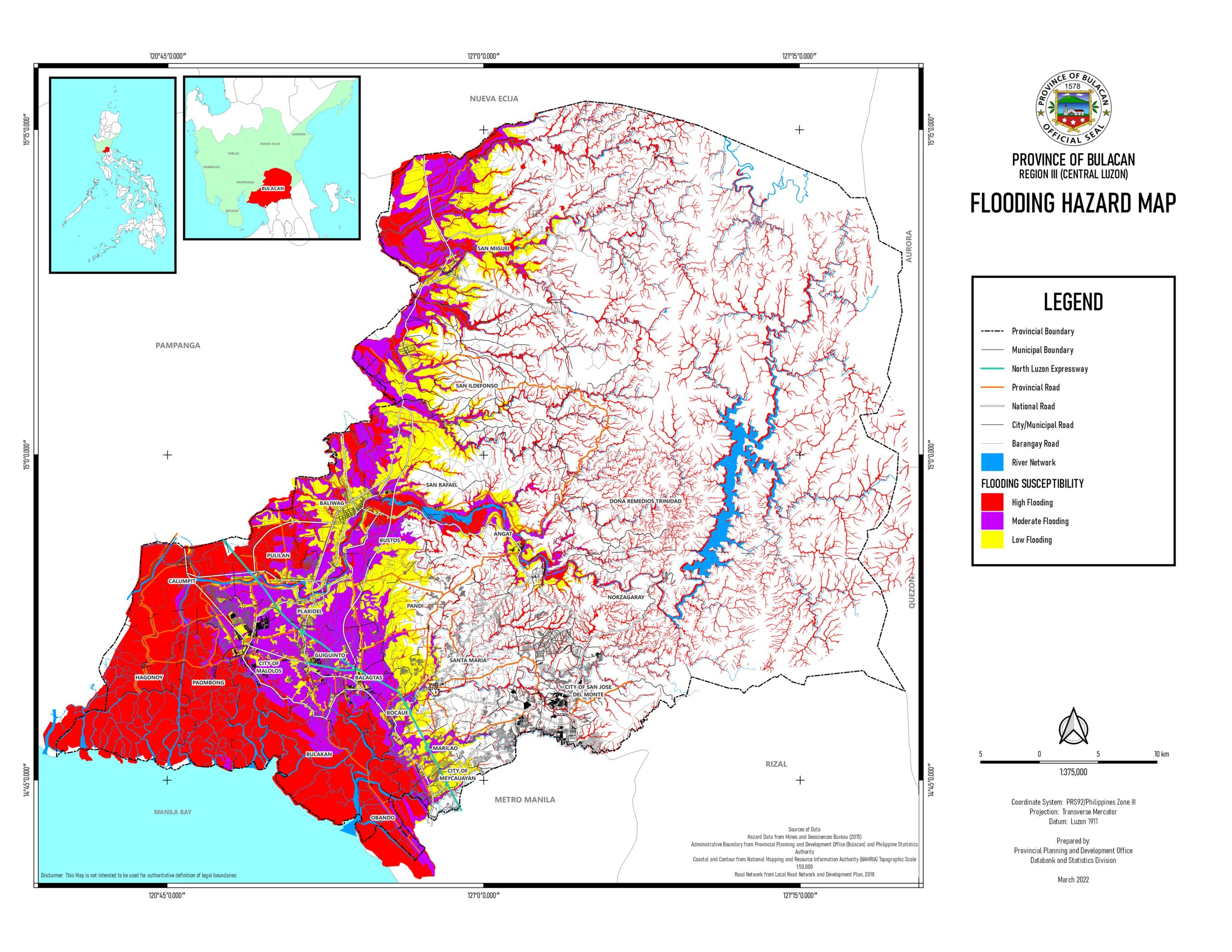
Provincial Disaster Risk Reduction and Management Office. (2022). Flooding hazard map. Provincial Government of Bulacan. https://pdrrmo.bulacan.gov.ph/wp-content/uploads/2022/03/FLOODING-HAZARD-MAP_LETTER-scaled.jpg
Quinn, T., Heath, S., Adger, W. N., Abu, M., Butler, C., Codjoe, S. N. A., Horvath, C., Martinez-Juarez, P., Morrissey, K., Murphy, C., & Smith, R. (2023). Health and wellbeing implications of adaptation to flood risk. AMBIO: A Journal of the Human Environment, 52(5), 952–962. https://doi.org/10.1007/s13280-023-01834-3 DOI: https://doi.org/10.1007/s13280-023-01834-3
Roy, C. L. (1976). Introduction to nursing: An adaptation model. Prentice-Hall.
Schwartz, D. (1989). Visual ethnography: Using photography in qualitative research. Qualitative Sociology, 12(2), 119–154. https://doi.org/10.1007/bf00988995 DOI: https://doi.org/10.1007/BF00988995
Turner, H., Rogers, B., Kneebone, S., Ramirez, D., French, M., Sawailau, M. J., Volavola, F., Baran, S., Matavesi, K., Newton, O., Luveniyali, M. B., Tela, A., & Vakarewa, I. (2025). Nothing about us without us: harnessing local voices in shaping community-based adaptation in the Pacific. Sustainability Science, 20(3), 877–902. https://doi.org/10.1007/s11625-025-01638-2 DOI: https://doi.org/10.1007/s11625-025-01638-2
Ugorji, L. O., Eze, B. U., & Ajadike, J. C. (2025). Indigenous adaptive strategies and community based flood mitigation in informal settlements of Aba Urban. Multidisciplinary Journal of Current Research and Review, 8(6), 1–17. https://doi.org/10.5281/zenodo.17658513
United Nations in Indonesia. (2025, September 16). Flood - definition and facts. https://indonesia.un.org/en/301573-flood-definition-and-facts
United Nations Office for Disaster Risk Reduction. (2025, May 27). GAR 2025 Hazard explorations: Floods. https://www.undrr.org/gar/gar2025/hazard-exploration/floods
Wang, C. C., & Burris, M. A. (1997). Photovoice: Concept, methodology, and use for participatory needs assessment. Health Education & Behavior, 24(3), 369–387. https://doi.org/10.1177/109019819702400309 DOI: https://doi.org/10.1177/109019819702400309
Wang, C. C., & Redwood-Jones, Y. A. (2001). Photovoice ethics: Perspectives from Flint Photovoice. Health Education & Behavior, 28(5), 560–572. https://doi.org/10.1177/109019810102800504 DOI: https://doi.org/10.1177/109019810102800504
Downloads
Published
How to Cite
Issue
Section
License
Copyright (c) 2026 Aron James Ching Tuazon, Regie De Jesus, Sheila Jhoy Querido, Trinity Anjhelene Pantaleon Nicerio, Carla Morada Prado

This work is licensed under a Creative Commons Attribution-ShareAlike 4.0 International License.




Sinta-2 JRCNP
MY ACCOUNT
ISSN


Collaboration

VISITORS NEW
Scopus Citedness

DIRECT MESSAGE

PLAGIARISM CHECKER

REFERENCE TOOLS

Keywords
Crossmark





-
1042
-
352
-
348
-
265
-
263