
The Relationship Between Self-Efficacy and Antiretroviral Medication Adherence Among People Living with HIV: A Cross-Sectional Study at CAKAP WPA Turen Foundation
DOI:
https://doi.org/10.58545/jrcnp.v4i2.1008Abstract
Background: Antiretroviral (ARV) therapy is essential for people living with HIV(PLHIV) to control viral replication and maintain long-term health. However, maintaining adherence to ARV therapy remains a challenge. Self-efficacy, defined as an individual's confidence in their ability to perform health-related behaviors, may play an important role in maintaining consistent adherence to ARV medication. Purpose: This study aimed to determine the relationship between self-efficacy and adherence to ARV medication among people living with HIV at Yayasan Cahaya Kasih Peduli WPA Turen, Malang Regency, Indonesia. Methods: This study used a quantitative descriptive-analytic design with a cross-sectional approach. The study involved 70 PLHIV selected using purposive sampling. Data were collected using a self-efficacy questionnaire and an ARV medication adherence questionnaire. Self-efficacy was categorized as high or low based on the instrument's predetermined cut-off score, while ARV adherence was categorized as adherent or non-adherent based on the adherence instrument's predetermined cut-off score. Data were analyzed using univariate and bivariate analyses, with statistical significance set at p≤0.05. Results: Of the 70 respondents, 48 (68.6%) had high self-efficacy and 22 (31.4%) had low self-efficacy. A total of 52 respondents (74.3%) were adherent to ARV therapy, while 18 (25.7%) were non-adherent. Among respondents with high self-efficacy, 42 (87.5%) were adherent and 6 (12.5%) were non-adherent, compared with 10 (45.5%) adherent and 12 (54.5%) non-adherent among those with low self-efficacy. Statistical analysis demonstrated a significant relationship between self-efficacy and ARV adherence (p=0.001). Respondents with high self-efficacy had seven times greater odds of adhering to ARV therapy than those with low self-efficacy (OR=7.00; 95% CI=2.20–22.28). Conclusions: Self-efficacy was significantly associated with ARV medication adherence among PLHIV at Yayasan Cahaya Kasih Peduli WPA Turen. Strengthening self-efficacy through continuous counseling, education, peer support, and community-based assistance may support sustained adherence to ARV therapy. Further longitudinal and intervention studies are recommended to determine the effectiveness of self-efficacy-based approaches in improving long-term ARV adherence.
Keywords:
Self-efficacy, Antiretroviral therapy, Medication adherence, People living with HIV, HIV/AIDSDownloads
References
Abdelgawad, M. (2026). The impact of health literacy on diabetic patients’ quality of life through self-management, self-care behaviours and glycaemic control in Eastern Mediterranean Region: A systematic review. Public Health Institute Journal. 6. https://openjournals.ljmu.ac.uk/PHIJ/article/view/2388
Ashaba, Baguma, C., Tushemereirwe, P., Nansera, D., Maling, S., Zanon, B. C., & Id, A. C. T. (2024). PLOS GLOBAL PUBLIC HEALTH Correlates of HIV treatment adherence self- efficacy among adolescents and young adults living with HIV in southwestern Uganda. 1–10. https://doi.org/10.1371/journal.pgph.0003600
Asmara, Y. V., Nurhayatun, E., & Putri, D. P. (2025). Duration vs Discipline : Uncovering Therapy Adherence Antiretrovirals in People with HIV. 10, 65–72. https://doi.org/10.26911/theijmed.2025.10.1.803
Ayieko, P., Willkens, M., Issarow, B., Deogratias, D., Fitzgerald, D. W., Grosskurth, H., Kisigo, G., Okello, E., Metsch, L. R., Peck, R. N., Kapiga, S., & Lee, M. H. (2026). Self-Efficacy and One-Year HIV Outcomes for Hospitalized People with HIV in Tanzania: A Mediation Analysis of the Daraja Clinical Trial. AIDS and Behavior, 30(4), 1022–1029. https://doi.org/10.1007/s10461-025-04917-2
Bwire, G. M., Njiro, B. J., Ndumwa, H. P., Munishi, C. G., Mpondo, B. C., Mganga, M., Mang’ombe, E., Bakari, M., Sangeda, R. Z., Sudfeld, C. R., & Killewo, J. (2023). Impact of differentiated service delivery models on retention in HIV care and viral suppression among people living with HIV in sub-Saharan Africa: A systematic review and meta-analysis of randomised controlled trials. Reviews in Medical Virology, 33(6), e2479. https://doi.org/10.1002/rmv.2479
Fauk, N. K., Gesesew, H. A., Seran, A. L., Raymond, C., Tahir, R., & Ward, P. R. (2022). Barriers to Accessing HIV Care Services in Host Low and Middle Income Countries: Views and Experiences of Indonesian Male Ex-Migrant Workers Living with HIV. International Journal of Environmental Research and Public Health, 19(21). https://doi.org/10.3390/ijerph192114377
Fauk, N. K., Gesesew, H. A., Seran, A. L., & Ward, P. R. (2023). Barriers to access to antiretroviral therapy by people living with HIV in an indonesian remote district during the COVID-19 pandemic: a qualitative study. BMC infectious diseases, 23(1), 296. https://doi.org/10.1186/s12879-023-08221-z
Fauk, N. K., Hawke, K., Mwanri, L., & Ward, P. R. (2021). Stigma and Discrimination towards People Living with HIV in the Context of Families, Communities, and Healthcare Settings: A Qualitative Study in Indonesia. International Journal of Environmental Research and Public Health, 18(10). https://doi.org/10.3390/ijerph18105424
Hosseini, Z., & Rad, R. E. (2024). Relationship between self ‐ efficacy and adherence to antiretroviral therapy in HIV / AIDS patients : An analytical cross ‐ sectional study in southern Iran. December 2023, 1–9. https://doi.org/10.1002/hsr2.1879
Hutahaean, B. S. H., Stutterheim, S. E., & Jonas, K. J. (2023). Barriers and Facilitators to HIV Treatment Adherence in Indonesia: Perspectives of People Living with HIV and HIV Service Providers. Tropical medicine and infectious disease, 8(3), 138. https://doi.org/10.3390/tropicalmed8030138
Ibrahim, K., Herliani, Y. K., Rahayuwati, L., Khadijah, S., & Sutini, T. (2022). Healthcare needs of people living with human immunodeficiency virus: A qualitative descriptive study. Nursing Open, 9(1), 349–357. https://doi.org/https://doi.org/10.1002/nop2.1071
Iryawan, A. R., Stoicescu, C., Sjahrial, F., Nio, K., & Dominich, A. (2022). The impact of peer support on testing , linkage to and engagement in HIV care for people who inject drugs in Indonesia : qualitative perspectives from a community ‑ led study. Harm Reduction Journal, 1–13. https://doi.org/10.1186/s12954-022-00595-8
Isabirye, R., Opii, D. J., Opio Ekit, S., Kawomera, A., Lokiru, L., Isoke, R., Ssenkaali, J., & Puleh, S. S. (2023). Factors Influencing ART Adherence Among Persons Living with HIV Enrolled in Community Client-Led Art Delivery Groups in Lira District, Uganda: A Qualitative Study. HIV/AIDS (Auckland, N.Z.), 15, 339–347. https://doi.org/10.2147/HIV.S414971
Liu, C., Yaremenko, A. V, Li, X., You, X., Zhu, X., Liu, N., Chen, W., Kong, N., Xie, T., Gaiha, G. D., Langer, R., & Tao, W. (2026). mRNA technology for the prevention and treatment of HIV-1 infection. Nature Reviews Bioengineering, 4(5), 435–453. https://doi.org/10.1038/s44222-025-00387-2
Øgård-Repål, A., Berg, R. C., Skogen, V., & Fossum, M. (2022). Peer support in an outpatient clinic for people living with human immunodeficiency virus: a qualitative study of service users’ experiences. BMC Health Services Research, 22(1), 549. https://doi.org/10.1186/s12913-022-07958-8
Saenjun, P., Vongsirimas, N., & Klainin-Yobas, P. (2025). Factors influencing antiretroviral therapy adherence among youth living with HIV: a systematic review and meta-analysis. BMC public health, 25(1), 4213. https://doi.org/10.1186/s12889-025-25357-6
Supriyatni, N., Agus Salim, L., Hargono, A., Sumiati, T., Lestari, T., & Andiani. (2025). Correlation of Self-Efficacy, Action Planning, and Coping Planning to ARV Adherence in HIV Patients in Ternate, Indonesia. Jurnal Kesehatan, 18(3), 375–386. https://doi.org/10.23917/jk.v18i3.12648
Sasono, T. N. ., & Hurrotaini, A. (2026). Impact of Household Food Security and Government Food Assistance on the Nutritional Status of PLHIV in Malang, Indonesia. Journal of Health and Nutrition Research, 5(2), 662–672. https://doi.org/10.56303/jhnresearch.v5i2.1150
WHO. (2021). Updated recommendations on service delivery for the treatment and care of people living with HIV. https://www.who.int/publications/i/item/9789240023581?utm_source=chatgpt.com
Yona, S., Edison, C., Nursasi, A. Y., & Ismail, R. (2023). Self-awareness as the key to successful adherence to antiretroviral therapy among people living with HIV in Indonesia: A grounded theory study. Belitung Nursing Journal, 9(2), 176–183. https://doi.org/10.33546/bnj.2480
Zahra, A. N., Waluyo, A., Yona, S., & Pakasi, T. A. (2024). Resilience in Relation to Adherence to Antiretroviral Therapy in People Living With HIV: A Qualitative Study. Global Qualitative Nursing Research, 11, 23333936241233450. https://doi.org/10.1177/23333936241233449
Downloads
Published
How to Cite
Issue
Section
License
Copyright (c) 2026 Tri Nurhudi Sasono, Nia Agustiningsih, Galuh Kumalasari, Lintang Puspita Prabarini, Ainun Hurrotaini, Lailatul Kodriyah, Ella Mayasari, Zahrah Saad

This work is licensed under a Creative Commons Attribution-ShareAlike 4.0 International License.




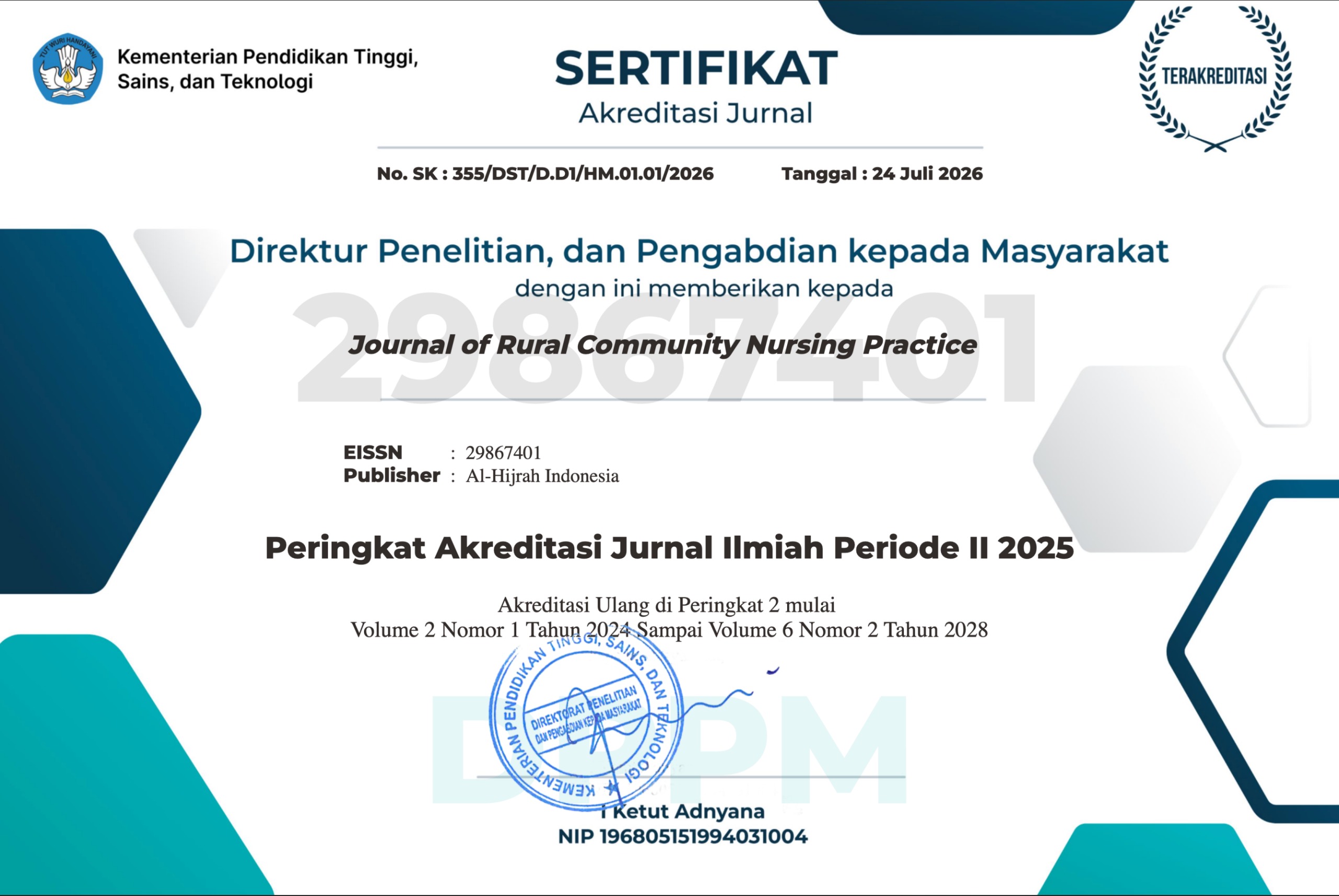
Sinta-2 JRCNP

MY ACCOUNT
ISSN
Collaboration
VISITORS NEW
Scopus Citedness

DIRECT MESSAGE

PLAGIARISM CHECKER

REFERENCE TOOLS

Keywords
Crossmark





-
1046
-
388
-
380
-
267
-
261